


Today we're launching the Google Blog Search Pinging Service, which is a way for individual bloggers and blog platform providers to inform us of content changes. Blogging providers who syndicate RSS/Atom/XML and want to be included in our Blog Search index can now ping us directly. We'll continue to monitor other pinging services and will contribute change notifications to the community. Read more at our FAQ.
Thursday, 5 October 2006
Today we're launching the Google Blog Search Pinging Service, which is a way for individual bloggers and blog platform providers to inform us of content changes. Blogging providers who syndicate RSS/Atom/XML and want to be included in our Blog Search index can now ping us directly. We'll continue to monitor other pinging services and will contribute change notifications to the community. Read more at our FAQ.
Wednesday, 4 October 2006
Today, the Google Groups team launched a new beta version, available to anyone at groups-beta.google.com. It may have been awhile since you thought of Groups as cool or sexy — if you ever did — but I couldn’t have been more excited to work on the team responsible for making the current Google Groups better. As a designer, I really relished the opportunity to make a Google product that’s been around for years more compelling and easier to use.
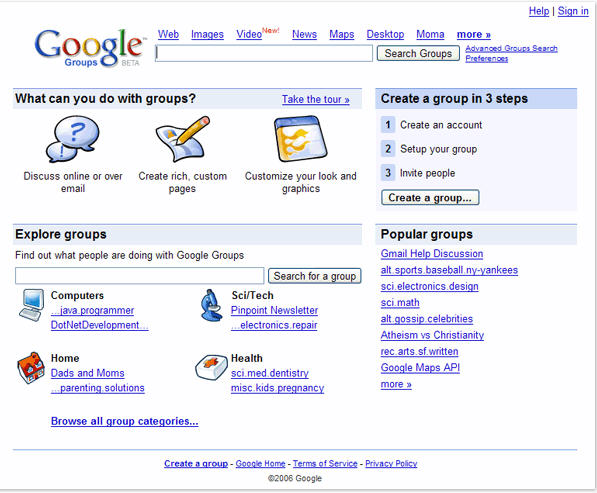
One of the things I'm happiest with in the beta version is the new design for individual groups. It’s cleaner and simpler, and yet manages to integrate a lot more features. Group owners can now create a welcome message, upload a group logo and customize your fonts and colors. You can make your group your own, in other words — something you had been telling us you really wanted.
Another thing I'm particularly proud of is the Pages feature, which lets you create web pages inside your group, and work on them with others. Instead of only offering rigid templates, we integrated many of the functions of Google Page Creator right into Groups, so you can create exactly what your group needs: an essay for school, the history your family, a web page with photos, a list of links, and so on.
Some of the other improvements to Groups include:
- Using Gmail's message cards for discussions, which makes them easier to follow
- Adding a Files section so users can share and collaborate on documents
- Helping groups have a better sense of their members with the Member area
Ever since we launched Google Accessible Search in July, one of the most oft-requested features has been the addition of advanced search capabilities similar to those available on the main Google Search page. In response, we've added an advanced search link at http://labs.google.com/accessible in order to refine your searches in various ways. The order of results will continue to take the accessibility of the search results into account.
Here are the types of advanced queries you can perform:
- restrict search to portions of a page, e.g., the title
- restrict search to results in a given language
- restrict searches to web pages found during a given time period
- restrict searches to content in a given file format
In India, a country saddled with one-third of the world's literacy problem, there are nearly 300 million people who are illiterate and 400 million who have only a rudimentary knowledge of the alphabet. That's 700 million people who cannot read even a newspaper headline.
As I wrote in December, PlanetRead employs Same Language Subtitling (SLS) to give subconscious reading practice for 30 minutes a week to more than 200 million early-literates in India, operating via 10 TV programmes in 10 languages. We’re hoping to take this project internationally, as well as collaborate with literacy organizations in other parts of the world. That’s why we’re so excited about The Literacy Project -— the initiative announced today by Google, the Frankfurt Book Fair literacy campaign (Litcam), and the UNESCO Institute for Lifelong Learning. (There's also a German version of the Google page.)
The project enables people to find everything -- from videos, books and scholarly articles about literacy to reading groups and literacy-related blogs. PlanetRead is one of the many organisations that is contributing. We’ve uploaded our subtitled videos (take a look!) and are sharing our own literacy research. And the site’s map of world literacy organisations also make it easier for us to connect with partner agencies who want to make literacy a way of life for everyone on this planet.
The idea that others around the world will be able to see what we’re doing —- and in turn, that we’ll be able to see what other people are doing and saying about literacy -— is thrilling, and at the very heart of PlanetRead’s mission to make its projects available to everyone. With each new person that we reach, we come one step closer to solving this truly global problem.
Tuesday, 3 October 2006
It's crazy over here -- in the last few months, we've had thousands of gadgets submitted for the Google Personalized Homepage. If you've used it, you've seen them -- those useful little units you can add, remove, and move around on your page. We have old-school games, clocks, calendars, and horoscopes. We've got a VAT calculator. We've got a pony.
 We've extended these gadgets to work on Google Desktop and Google Pages, but it occurred to us that these would be slick on other people's web pages, too.
Today we're opening up our gadget inventory for your viewing and cloning pleasure. In other words, now you can copy and paste some simple HTML to add the Google Gadgets you like to your own webpage. Check out our directory of Google Gadgets for your webpage to see all the options. And as always, if you can't find one like the one you had in mind, you can always write a gadget yourself.
We just launched a new version of the Google AJAX Search API, which is designed to make it easier for webmasters and developers to do two things:
- Add a search box to your site that displays Google Web, Video, News, Maps, and Blog Search results without taking users to a separate page.
- Build powerful web apps on top of Google search. (See some samples.)
Here's another way it pays to use Google Checkout: there's a $10 bonus on purchases of $30 or more at participating stores.
Subscribe to:
Posts (Atom)


