A Company

  • Subscribe to our RSS feed.
  • Twitter
  • StumbleUpon
  • Reddit
  • Facebook
  • Digg

Friday, 21 October 2005

Guess what just turned 34?

Posted on 15:19 by Unknown
Posted by Paul Buchheit, Gmail Engineer

It's difficult to pin down the exact origin of email, but in October 1971, an engineer named Ray Tomlinson chose the '@' symbol for email addresses and wrote software to send the first network email.

At the time, it must not have seemed very important – nobody bothered to save that first message or even record the exact date. I've always thought that it would be fun to witness a little bit of history like that – to be there when something important happened. That's part of what drove me to join a little no-name startup named Google, and it's why I was excited when I was given a chance to create a new email product, now called Gmail.

Of course that wasn't the only reason why I wanted to build Gmail. I rely on email, a lot, but it just wasn't working for me. My email was a mess. Important messages were hopelessly buried, and conversations were a jumble; sometimes four different people would all reply to the same message with the same answer because they didn't notice the earlier replies. I couldn't always get to my email because it was stuck on one computer, and web interfaces were unbearably clunky. And I had spam. A lot of it. With Gmail I got the opportunity to change email – to build something that would work for me, not against me.

We had a lot of ideas, but first we spent a lot of time talking to all kinds of people about their email. They let us watch over their shoulders and helped us really understand how they use email and what they need from it. We didn't want to simply bolt new features onto old interfaces. We needed to rethink email, but at the same time we needed to respect that email already had over 30 years of history, thousands of existing programs, and nearly a billion users. So we started by learning which features were most important, and which problems were most aggravating. We also realized that solving everyone's problems was too big of a challenge for the first release. It would be better to build a product that a lot of people love, than one that everyone tolerates, and so that was our goal.

On April 1, 2004, we rolled out the first release of Gmail. It immediately became known for giving away 1000 MB of storage, while the others only offered 4 MB, as they had for many years. We didn't do that just for the attention (although we certainly got our share). It's just part of our philosophy. We always want to do as much as we can for our users, and so if we can make something free, we will.

But storage was only the most obvious difference, and our other improvements were just as important. Gmail included a quick and accurate search. It introduced powerful new concepts to organize email, such as the conversation view (so now I can finally see all those replies at once). It provided a fast and dynamic interface from web browsers everywhere, popularizing the techniques that have since become known as AJAX.

This interface included many important features not commonly found on the web at that time, such as email address auto-completion, a slick spell-checker, keyboard shortcuts, and pages that update instantly. It included a smart spam filter to get rid of junk mail. Finally, we made an important new promise: you can keep your Gmail address and all of your email, even if you someday decide that Gmail is not for you. Cell phone owners already have the right to keep their old phone number when switching to a new provider, and you should have that same freedom with email. To ensure this freedom, Gmail provides, for free, both email forwarding and POP download of all your mail. Many services are now beginning to include other Gmail innovations; we hope that some day they will also be willing to include this one.

Of course, the launch was just the beginning, and we're still busy improving Gmail. We keep increasing free storage (2656 MB and counting), we offer the interface in 38 languages, and we now have features such as auto-save drafts, so that you don't accidentally lose that half-written message. We know that Gmail isn’t quite right for everyone yet. We’re working on that too – there’s still more we can do for the folder-lovers and devout-deleters out there. But wait, there’s more! :) We also have a new batch of exciting innovations on the way that we hope will shake things up again and make Gmail even better for even more people.

I'm proud of what we've done so far, and am excited about our future plans for Gmail. So celebrate how far email has come by joining its fun future.
Read More
Posted in apps | No comments

Wednesday, 19 October 2005

Why we believe in Google Print

Posted on 20:54 by Unknown
Posted by David Drummond, General Counsel and Vice President, Corporate Development

We've been asked recently why we're so determined to pursue Google Print, even though it has drawn industry opposition in the form of two lawsuits, the most recent coming today from several members of the American Association of Publishers. The answer is that this program, which will make millions of books easier for everyone in the world to find, is crucial to our company's mission. We're dedicated to helping the world find information, and there's too much information in books that cannot yet be found online. We think you should be able to search through every word of every book ever written, and come away with a list of relevant books to buy or find at your local library. We aim to make that happen, but to do so we'll need to build and maintain an index containing all this information.

It's no surprise that this idea makes some publishers nervous, even though they can easily remove their books from the program at any time. The history of technology is replete with advances that first met wide opposition, later found wide acceptance, and finally were widely regarded as having been inevitable all along. In 1982, for instance, the president of the Motion Picture Association of America famously told a Congressional panel that "the VCR is to the American film producer and the American public as the Boston Strangler is to the woman home alone." But Sony, makers of the original Betamax, stood its ground, the Supreme Court ruled that copying a TV show to watch it later was legal, and today videotapes and DVDs produce the lion's share of the film industry's revenue.

We expect Google Print will follow a similar storyline. We believe that our product is legal (see Eric Schmidt's recent op-ed), that the courts will vindicate this position, and that the industry will come to embrace Google Print's considerable benefits. Even today, despite its lawsuit, the AAP itself recognizes this potential. The Google Print Library Program, AAP president Pat Schroeder said this morning, "could help many authors get more exposure and maybe even sell more books.” We look forward to the day that the program's opponents marvel at the fact that they actually tried to stop an innovation that, by making books as easy to find as web pages, brought their works to the attention of a vast new global audience.
Read More
Posted in books + book search, policy and issues | No comments

The point of Google Print

Posted on 14:04 by Unknown
Posted by Adam Mathes, Associate Product Manager, Google Print Team

You may have read about the AAP's lawsuit announced today which objects to Google Print. We'll post our comments about that soon. Meanwhile, we offer this commentary from Eric Schmidt. It ran on the op-ed page of yesterday's Wall Street Journal, and we are reprinting it in full with that paper's permission.

Books of Revelation
By Eric Schmidt
The Wall Street Journal
October 18, 2005

Imagine sitting at your computer and, in less than a second, searching the full text of every book ever written. Imagine an historian being able to instantly find every book that mentions the Battle of Algiers. Imagine a high school student in Bangladesh discovering an out-of-print author held only in a library in Ann Arbor. Imagine one giant electronic card catalog that makes all the world's books discoverable with just a few keystrokes by anyone, anywhere, anytime.

That's the vision behind Google Print, a program we introduced last fall to help users search through the oceans of information contained in the world's books. Recently, some members of the publishing industry who believe this program violates copyright law have been fighting to stop it. We respectfully disagree with their conclusions, on both the meaning of the law and the spirit of a program which, in fact, will enhance the value of each copyright. Here's why.

Google's job is to help people find information. Google Print's job is to make it easier for people to find books. When you do a Google search, your results now include pointers to those books whose contents, stored in the Google Print index, contain your search terms. For many books, these results will, like an ordinary card catalog, contain basic bibliographic information and, at most, a few lines of text where your search terms appear.

We show more than this basic information only if a book is in the public domain, or if the copyright owner has explicitly allowed it by adding this title to the Publisher Program (most major U.S. and U.K. publishers have signed up). We refer people who discover books through Google Print to online retailers, but we don't make a penny on referrals. We also don't place ads on Google Print pages for books from our Library Project, and we do so for books in our Publishing Program only with the permission of publishers, who receive the majority of the resulting revenue. Any copyright holder can easily exclude their titles from Google Print -- no lawsuit is required.

This policy is entirely in keeping with our main Web search engine. In order to guide users to the information they're looking for, we copy and index all the Web sites we find. If we didn't, a useful search engine would be impossible, and the same dynamic applies to the Google Print Library Project. By most estimates, less than 20% of books are in print, and only around 20% of titles, according to the Online Computer Library Center, are in the public domain. This leaves a startling 60% of all books that publishers are unlikely to be able to add to our program and readers are unlikely to find. Only by physically scanning and indexing every word of the extraordinary collections of our partner libraries at Michigan, Stanford, Oxford, the New York Public Library and Harvard can we make all these lost titles discoverable with the level of comprehensiveness that will make Google Print a world-changing resource. But just as any Web site owner who doesn't want to be included in our main search index is welcome to exclude pages from his site, copyright-holders are free to send us a list of titles that they don't want included in the Google Print index.

For some, this isn't enough. The program's critics maintain that any use of their books requires their permission. We have the utmost respect for the intellectual and creative effort that lies behind every grant of copyright. Copyright law, however, is all about which uses require permission and which don't; and we believe (and have structured Google Print to ensure) that the use we make of books we scan through the Library Project is consistent with the Copyright Act, whose "fair use" balancing of the rights of copyright-holders with the public benefits of free expression and innovation allows a wide range of activity, from book quotations in reviews to parodies of pop songs -- all without copyright-holder permission.

Even those critics who understand that copyright law is not absolute argue that making a full copy of a given work, even just to index it, can never constitute fair use. If this were so, you wouldn't be able to record a TV show to watch it later or use a search engine that indexes billions of Web pages. The aim of the Copyright Act is to protect and enhance the value of creative works in order to encourage more of them -- in this case, to ensure that authors write and publishers publish. We find it difficult to believe that authors will stop writing books because Google Print makes them easier to find, or that publishers will stop selling books because Google Print might increase their sales.

Indeed, some of Google Print's primary beneficiaries will be publishers and authors themselves. Backlist titles comprise the vast majority of books in print and a large portion of many publishers' profits, but just a fraction of their marketing budgets. Google Print will allow those titles to live forever, just one search away from being found and purchased. Some authors are already seeing the benefits. When Cardinal Ratzinger became pope, millions of people who searched his name saw the Google Print listing for his book "In the Beginning" (Wm. B. Eerdmans) in their results. Thousands of them looked at a page or two from the book; clicks on the title's "Buy this Book" links increased tenfold.

That's the heart of the Google Print mission. Imagine the cultural impact of putting tens of millions of previously inaccessible volumes into one vast index, every word of which is searchable by anyone, rich and poor, urban and rural, First World and Third, en toute langue -- and all, of course, entirely for free. How many users will find, and then buy, books they never could have discovered any other way? How many out-of-print and backlist titles will find new and renewed sales life? How many future authors will make a living through their words solely because the Internet has made it so much easier for a scattered audience to find them? This egalitarianism of information dispersal is precisely what the Web is best at; precisely what leads to powerful new business models for the creative community; precisely what copyright law is ultimately intended to support; and, together with our partners, precisely what we hope, and expect, to accomplish with Google Print.

Mr. Schmidt is CEO of Google.
Read More
Posted in books + book search, policy and issues | No comments

Monday, 17 October 2005

We get letters (3)

Posted on 16:18 by Unknown
Posted by Karen Wickre, Google Blog team

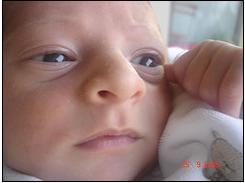
This just in: Walid Elias Kai, a Ph.D. in search engine marketing, is, it must be said, an avid fan of our company. Dr. Kai, who is Lebanese, and his Swedish wife Carol live in Kalmar, Sweden, where their son was born on September 12. His name? Oliver Google Kai.

About this choice, Dr. Kai writes, "When we first knew that my wife Carol is pregnant, I said, 'we will name our child Google.' Everyone laughed and did not take me seriously. My brother said, 'Yeah, name the next one yahoo fuji nikon." And then, says Dr. Kai, the day came to make the baby official in the Swedish Registry. "I was with my friend Magnus Foss and my wife Carol, and I said yes, GOOGLE KAI. Carol knew how serious I am – she knows how much I adore Google services."

Clearly not one to shy away from a unique moniker, Dr. Kai also tells us that in the Lebanese tradition both parents have a name related to the child. "All our friends and families are calling us Abou Google (Google's father) and Emm Google (Google's mother)."

Of course, there's a website devoted to young Mr. Kai. We wish him long life and good health, and hope his schoolmates aren't too hard on him.

Read More
Posted in | No comments

Friday, 14 October 2005

Our ongoing privacy efforts

Posted on 16:28 by Unknown
Posted by Nicole Wong, Associate General Counsel

We updated our privacy policy today. We know privacy is important to our users, and it's important to us, too. That's why we work hard to let people know how we collect and use personal information to provide our services. A clearly written privacy policy is part of this effort. In this update, most of the terms are the same, but there are two important differences:

First, we created a short, one-page "highlights" notice summarizing our privacy practices. We hope this is easy to digest and understand at a glance. Second, we provided even more detail about our privacy practices in the full-text privacy policy and lots more detail in the accompanying FAQs. The goal of both is to help you make informed choices about using our services.

Designing privacy protection and user choice into Google products is an ongoing effort. Please let us know how we're doing.
Read More
Posted in policy and issues, privacy | No comments

Thursday, 13 October 2005

More Firefox-Toolbar synchronicity

Posted on 21:25 by Unknown
Posted by Ben Lewis, Firefox Toolbar product manager

If you’ve been holding off on upgrading to Firefox 1.5 Beta 2 because you’d miss out on great toolbar features like Suggest and Spell Check, then wait no more! The latest version of the Google Toolbar is fully compatible with the newest rev of Firefox.
Read More
Posted in apps | No comments

Financial reporting: the alphabet soup

Posted on 06:01 by Unknown
Posted by Mark Fuchs, Chief Accountant

Warning: Financial reporting minutiae below. Proceed with caution.

We're going to provide a bit more information with our October 20 earnings announcement. In this and future announcements, we're going to include a so-called pro-forma, or non-GAAP, diluted earnings per share (EPS) number as a supplement to our GAAP EPS number.

In the past, we've only provided GAAP EPS. But because Wall Street analysts typically estimate and describe our results with non-GAAP EPS numbers, that resulted in some confusing apples-to-oranges analyses of our results. (By the way, we review non-GAAP results when we analyze our own performance.) By providing both, we hope it will be easier to understand our results.

Now, if you’ve got your green eyeshade handy, read on. What follows is in accountant-speak.

Earnings per share is calculated by dividing profit (net income) by the number of outstanding shares. That's GAAP. To compute our non-GAAP EPS, we’ll add back to our net income things such as charges for stock-based compensation. (Before adding back stock-based compensation – or other certain charges – we’ll factor in related taxes. What does that mean? When we add back a charge, we subtract the tax benefit related to it that we would get under GAAP accounting. In other words, in the non-GAAP calculation we don't want to include the GAAP tax benefit.) After tax-affecting the charges and then adding them back to net income, we'll take that sum, divide it by outstanding shares and come up with our non-GAAP EPS number.

To illustrate all of this with a fictitious example, let's assume these imaginary data points:
  • GAAP net income - $300 million
  • Stock-based compensation charge - $100 million (note that other charges in addition to stock-based compensation may be excluded from the computation and presentation of our non-GAAP results as appropriate in the future)
  • Tax affect of stock based compensation charge - $35 million
  • Shares outstanding for Google - 600 million
To get our GAAP EPS, we would simply divide $300 million GAAP net income by the 600 million shares outstanding and arrive at a GAAP EPS of $0.50.
$300,000,000 / 600,000,000 = $0.50
Now, to get the non-GAAP EPS, we would:
  1. Subtract the $35 million tax affect from the $100 million stock-based compensation charge to arrive at $65 million
  2. Add that $65 million to the $300 million GAAP net income for a new, non-GAAP net income of $365 million
  3. Divide $365 million by 600 million shares outstanding and get a non-GAAP EPS of $0.61.
($300,000,000 + ($100,000,000 - $35,000,000)) / 600,000,000 = $0.61
As if this weren't complicated enough, we should note that most, if not all, analysts have historically computed our non-GAAP earnings by adding stock-based compensation to net income without tax-affecting the charge. As a result, when we provide our non-GAAP EPS number, we may be adding back less to compute our non-GAAP earnings than will most of the analysts.

Using the same set of imaginary numbers, analysts might, for example:
  1. Add the full $100 million stock-based compensation charge to the GAAP net income of $300 million and arrive at their non-GAAP net income of $400 million
  2. Divide that by outstanding shares and arrive at non-GAAP EPS (for the fictitious example, $0.67 per share)
($300,000,000 + $100,000,000) / 600,000,000 = $0.67
Congratulations to those of you who were able to make it this far. We're sorry for the density, but this is dense stuff and we've got to be comprehensive in our explanation of it.
Read More
Posted in googlers and culture | No comments
Newer Posts Older Posts Home
Subscribe to: Posts (Atom)

Popular Posts

  • On the alert for bloggers
    Posted by Naga Sridhar Kataru, Software Engineer So many interesting blogs and so little time! If you're anything like me, you like to p...
  • About that fake post
    Posted by Karen Wickre, Google Blog team A bug in Blogger enabled an unauthorized user to make a fake post on the Google Blog last night, cl...
  • Google Print and the Authors Guild
    Posted by Susan Wojcicki, Vice President, Product Management Today we learned that the Authors Guild filed a lawsuit to try to stop Google P...
  • Feed the world
    Posted by Chris Wetherell, Software Engineer, Google Reader So we've added a new experiment to Google Labs: Google Reader , a service w...
  • Two more Gmail languages
    Posted by Shanjian Li, Gmail Engineer We've just launched Arabic and Hebrew language interfaces for Gmail, as well as several new featu...
  • Make your computer just work
    Posted by Jesse Savage, Google Pack team So you bought a new PC for yourself or a relative during the holidays. There was the initial excit...
  • An update on payments
    Posted by Benjamin Ling, Product Manager & Tom Oliveri, Product Marketing Manager There's been a lot of interest and speculation abo...
  • The illuminated continent
    Posted by Michael Jones, Google Earth CTO Have you ever dreamed of Africa while reading National Geographic ? The exotic photographs and tho...
  • Guest Bloggers: those Freakonomics Guys
    Posted by Steven D. Levitt and Stephen J. Dubner We didn't know quite what to expect at Google during our visit last week. A few months ...
  • Eureka! Your own search engine has landed!
    Posted by Shashi Seth and R.V. Guha, Google Co-op team Wouldn't it be cool if you could easily build a search engine on your blog or web...

Categories

  • accessibility
  • ads
  • Africa
  • apps
  • April 1
  • Asia
  • books + book search
  • crisis response
  • developers
  • doodles
  • education and research
  • enterprise
  • Europe
  • free expression
  • google.org
  • googlers and culture
  • green
  • health
  • Latin America
  • mobile
  • online safety
  • personalization
  • photos
  • policy and issues
  • privacy
  • recipe
  • recruiting and hiring
  • scholarships
  • search
  • search trends
  • small business
  • user experience and usability
  • youtube and video

Blog Archive

  • ▼  2006 (231)
    • ▼  October (27)
      • On the alert for bloggers
      • Scary stories
      • Do you "Google?"
      • Google Earth voter guide
      • Eureka! Your own search engine has landed!
      • The rebirth of cool
      • Heading to the X Prize Cup
      • Eric and the NAE
      • Looking for Google Talk stories
      • Corporate solar is coming
      • Maps in the Palm in your hand
      • Music for your eyes
      • Teacher's helper
      • Better together: Docs & Spreadsheets
      • Score one for the Sun Devils
      • Greetings, Earthlings!
      • Inside Macs at Google
      • About that fake post
      • Our security stance
      • More developer love with Google Code Search
      • Got blog? Will ping.
      • The new Groups experience
      • Accessible Search now has advanced search features
      • The Literacy Project
      • Yes, you can have a pony
      • Create web apps on top of Google search
      • Discount with Checkout
    • ►  September (26)
    • ►  August (32)
    • ►  July (18)
    • ►  June (25)
    • ►  May (19)
    • ►  April (20)
    • ►  March (20)
    • ►  February (26)
    • ►  January (18)
  • ►  2005 (199)
    • ►  December (18)
    • ►  November (20)
    • ►  October (20)
    • ►  September (27)
    • ►  August (20)
    • ►  July (14)
    • ►  June (11)
    • ►  May (18)
    • ►  April (16)
    • ►  March (21)
    • ►  February (7)
    • ►  January (7)
  • ►  2004 (58)
    • ►  December (11)
    • ►  November (6)
    • ►  October (15)
    • ►  September (7)
    • ►  August (2)
    • ►  July (4)
    • ►  June (5)
    • ►  May (7)
    • ►  April (1)
Powered by Blogger.

About Me

Unknown
View my complete profile